In February 2025, following submissions to the Geneva-based International Union for the Conservation of Nature, its task force on marine mammal protected areas accepted the island’s application as an Important Marine Mammal Area (IMMA).
An IMMA is defined as a discrete portion of habitat, key for marine mammal species, with the potential to be delineated and managed for conservation.
While they are not legal designations, they are viewed as independent, peer-reviewed assessment areas.
Andrew Stevenson, of Whales Bermuda, who led the application, said it involved documenting the designated waters as reproductive areas for humpback whales, a feeding area and migratory route, with a rationale for the boundary delineation and a detailed description of habitat.
It included references to published papers and presentations that he authored or co-authored.
Mr Stevenson highlighted the efforts of volunteers with individual and corporate donors, the Atlantic Conservation Partnership and the Sargasso Sea Commission.
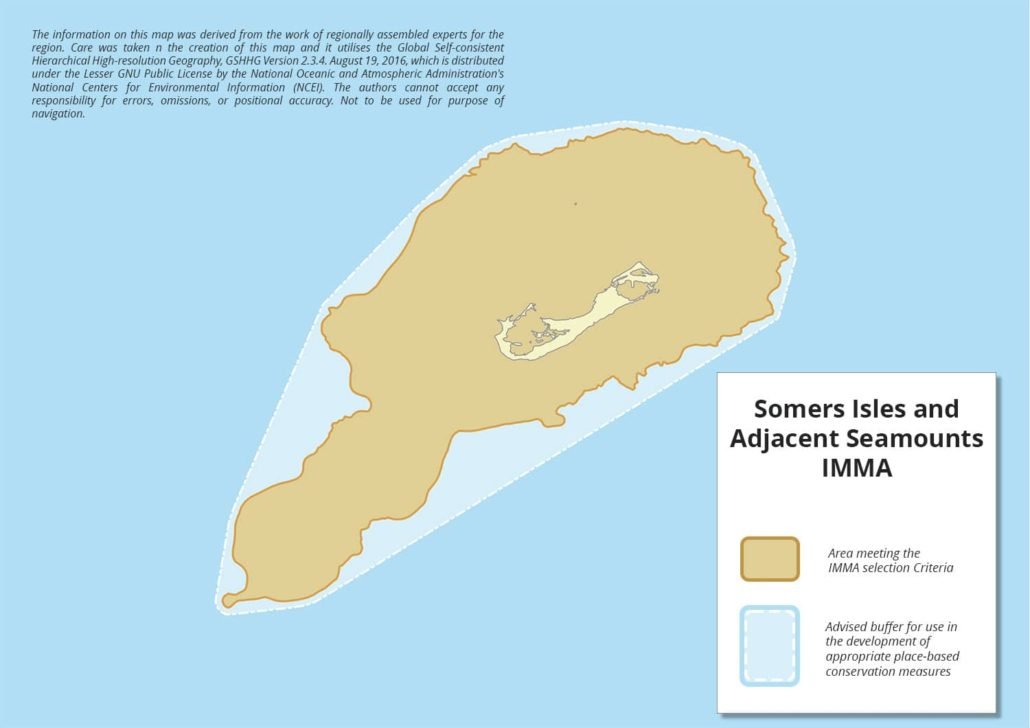
Bermuda, also known as the Somers Isles, is an isolated group of mid-oceanic islands. Located approximately 1,000km from the United States coastline, the IMMA includes shelf and deep waters closely following the steep 2,000m isobath of the Bermuda Platform around the two adjacent seamounts. While the Islands themselves cover 55 square kilometres, the IMMA area is approximately 3,097 square kilometres and contains two adjacent seamounts to the southwest of the Somers Isles, the Challenger and Argus Banks. The IMMA hosts seasonal aggregations of North Atlantic humpback whales (Megaptera novaeangliae) that use the area as a stopover point on both the northern and southern migrations, as well as an important area for feeding, calving, and nursing young. Pilot and sperm whales also occur but these are presently not commonly observed. The waters around Bermuda were designated a Marine Mammal Sanctuary in 2012 and the IMMA is surrounded by, but not included in the Sargasso Sea Ecologically or Biologically Significant Marine Area described in 2012.